Menelik
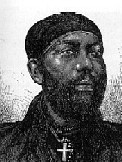
Menelik was born in August 1844. His father Haile Menekot, was king of Shewa from 1847 to 1855. Haile Menekot died in 1855 after losing a battle to emperor Tewodros (Prouty, C. and Rosenfeld, E. 1982, 129). Menelik was set to be the next ruler of Shewa but was taken away by Tewodros to Magdala. In his place, Tewodros had made Ato Bezabeh governor of Shewa (Gabre-Sellassie, Z. 1975, 19). At Magdala, Menelik was treated like a prince. He was raised alongside Tewodros' own sons and was given education and training befitting a child of a ruler. Menelik said of Tewodros: "he always loved me as a son" (Marcus 23).
Ten years later, in 1865, Menelik escaped Tewodros' imprisonment and, with the help of family and friends, became the ruler of Shewa. He would remain the ruler of Shewa for another 24 years before he became emperor upon Yohannes' death in 1889 (Pankhurst, R. 1998, 176).
Ato Bezabeh fled upon the return of Menelik to Shewa in 1865. Menelik was officially recognized king of Shewa in August of that year. In April 1868, when the British came to dethrone Tewodros in Magdala, Menelik sent an army to Magdala hoping to claim the imperial throne upon Tewodros' fall. Menelik had asked the British to help him in his plan, but the British did not really care who became the next emperor so they denied him of any assistance. At the last minute, Menelik changed his mind and had his army back off, making the excuse that he would not have his men do battle on Easter. After the British left Magdala, Wagshum Gobaze, the ruler of Amhara, Wag, and Lasta, took Magdala and proclaimed himself emperor. Menelik had lost his first chance at the imperial throne to Gobaze and will still have to wait until Yohannes' death to become emperor (Gabre-Sellassie, Z. 1975, 19-21).
Wagshum Gobaze, now calling himself Emperor Tekle Giyorgis II, remained emperor for only a short three years, from 1868 to 1871. When the British had stormed Magdala in 1868, they had done it with the cooperation of a certain Kassa Marcha of Tigray. After the British finished their campaign, they awarded Kassa Marcha for his cooperation by giving him a number of weapons. When the current emperor, Tekle Giyorgis, attacked Tigray because Kassa had refused to submit, Kassa was able to crush the imperial army because his troops, although outnumbered, were better equipped. Kassa went on to become the next emperor in 1872 with the name Yohannes IV.
During Yohannes' nearly two decade rule, Menelik was mostly faithful. Menelik would respond when Yohannes asked him to suppress a revolt and he respected territorial boundaries carved out for him by Yohannes. However, Menelik's ambition to become emperor was too great and was always looking for a way to dethrone Yohannes. In 1875 Menelik started communication with the khedive of Egypt hoping he could make them an alley. Through Egypt, Menelik hoped he could obtain access to the seacoast and a supply of firearms. Later that same year, the Egyptians tried to make Menelik part of their plot against Yohannes, but before real measures were taken, the Egyptian's plan failed by their own undoing (Gabre-Sellassie, Z. 1975, 57-59). In 1876, Menelik had his aspirations on the French. He wanted to open a trade route to Obock, a French-ruled seaport located in what is today Djibouti. Menelik sent a draft treaty to France and he made it know a substantial amount of land in Shewa would be available for a French settlement (Gabre-Sellassie, Z. 1975, 85-86). Nothing came out of this attempt either but Menelik's most daring move was still ahead of him.
While Yohannes was preoccupied with defending the country against the Egyptians, Menelik saw it as a perfect opportunity to expand his territory north. Menelik started in the summer of 1876 by invading Wallo. Early the following year, Menelik was in Begemdir. During this ordeal, Yohannes was camped at Adwa. It wasn't until March of 1877 that Yohannes finally left Adwa. Yohannes slowly advanced south and Menelik retreated back to Shewa. When Yohannes reached Shewa, Menelik was contemplating whether to do battle with the emperor or to submit. Yohannes was willing not to fight as long as Menelik submitted. Finally Menelik submitted to Yohannes on 10 March 1878. Menelik promised to pay annual tribute, to cease trade routes to European ruled territories, and to be faithful to the emperor. In exchange, Menelik got to keep his land and was anointed by the emperor as king of Shewa (Gabre-Sellassie, Z. 1975, 89-93).
Upon emperor Yohannes' suggestion, Menelik married Taitu Betul. Her brothers were imprisoned with Menelik in Magdala during Tewodros' rule. The wedding took place in the Church of Medhane Alem in Ankober in the spring of 1883. Paul Henze describes her as being "bright, energetic, patriotic, a devout Christian and unusually well educated for her time." (2000, 151).
For much of the 1880s, Menelik's expansion campaigning towards the south greatly increased the size of Shewa. Eastern Gurage was concurred without much resistance where as the western side required heavy fighting measures. Heavy fighting was also necessary to concur Arsi. After defeating King Tekle Haymanot of Gojjam in 1882, Menelik was able to occupy Leqa Naqamté, Leqa Qellem, Jemma, the Gibé states, and Illubabor. Later on, Menelik "took control of Kulo and Konta in 1889. He began the occupation of Kambata in 1890, occupied Ogaden, Balé and Sidamo in 1891, and gained control of Gofa and conquered Walamo . . . in 1894, and took Kafa three years later." One of his last great concur as king of Shewa was Harar. Paul Henze writes that "Menelik consciously extended his borders to include all the territories that had formed part of the medieval empire of Amde Tseyon." (2000, 152).
When the Egyptians evacuated Harar in May 1885, it was taken over by Emir Abdullahi. He was a Muslim fundamentalist who persecuted Christians. When Italian Christians were killed in Ogaden in April 1886, supposedly ordered by the emir, Menelik saw it as an excuse to interpose. Before Menelik attacked, he offered the emir autonomy. The emir refused the offer and opened attack on Menelik on 6 January 1887. Menelik's troops were far superior and the emir was defeated. The emir fled to the Somali desert to hide. Menelik appointed his cousin Makonnen as governor of Hara. The city would go on to become an economic center allowing Shewa a better access to the French Gulf of Tadjoura (Marcus, H. 2002, 83-4).
Yohannes was unexpectedly killed at the Battle of Matamma on 9 March 1889. The heir apparent was Yohannes' son, Megesha, but neither he or any one else could match Menelik's power. Menelik quickly began touring north receiving submission from local officials. Shortly afterwards, Menelik began negotiating with the Italians because he wanted them to officially recognize him as emperor of Ethiopia. On 2 May 1889, the Italians and Menelik signed the infamous Treaty of Wichale (Marcus, H. 2002, 87-9). There were two versions made; the Amharic version gave Menelik the choice of "using Italy's good offices for contacts with other countries. The Italian version obligated Menelik to make all such contacts through Italy, thus making Ethiopian an Italian protectorate." (Henze, P. 2000, 161). When Menelik II discovered the misunderstanding, he immediately wrote to Britain's Queen Victoria, to the ruler of Germany, and to the president of France insisting that Ethiopia was still an independent nation. In 1893, Menelik II denounced the treaty and by 1895 Ethiopia and Italy were at war. On March 1896 Menelik's troops crushed the Italian army at Adwa, Ethiopia. Later, Italy did recognize Ethiopia as an independent nation.
After the Battle of Adwa, Menelik refocused his attention to expanding Ethiopia's territory further south and west. One of the first major acquirement was of Kefa in 1897. One major obstacle was the British; they were in control of regions that are today Kenya and Sudan. The threat was not going to hinder Menelik; he continued expanding into territories the Europeans believed were theirs. As well as expanding Ethiopia's frontiers, Menelik did much to modernize the country. During his reign, electricity, the telephone, and indoor plumping where introduced. Advancements in health and education were made and Ethiopia become a member of the International Postal Union. His most outreaching achievement was the construction of the railway from Addis Abeba to Djibouti. It was instrumental in connecting the country to the outside world as well as increasing trade commerce (Marcus, H. 2002, 104-8).
In 1906, Menelik had a stroke related to a disease which would eventually take his life. In 1907 he institutionalized a ministerial system to the government. The ministry would later become vital when Menelik fell seriously ill. In May 1909, Menelik named his grandson, Iyasu, his successor. Because Iyasu was a minor at the time, Ras Tasamma Nadaw was named regent. However, the most powerful person in Ethiopia at the time was Taytu, Menelik's wife. Her reign was short-lived for she had far more opponents than supporters. Her opponents, includeing the regent, used the imperial army, the church, and other political means to bring Taytu down. In 1910, Taytu was forced out of power. She fled to Saint Maryam at Entotto, where she retired until her death (Zewde, B. 2001, 111-120).
Iyasu took over power in 1911 when regent Ras Tasamma Nadew passed away. Thus began the short reign of Iyasu, which ended in 1916. Menelik died in December of 1913 and the country fell into a period of uncertainty. The next true leader, Haile Selassie, was not crowned until 1930.
Marcus, Harold G. The Life and Times of Menelik II: Ethiopia 1844-1913. The Red Sea Press, 1995.