The Nine Saints
In 451 AD, the Council of Chalcedon declared Monophysitism heretical. Those that fled the Byzantine Empire to escape anti-Monophysitism prosecution settled in Egypt, Arabia, and Ethiopia (Ullendorff 1960, 101). Those Christians were known as Tsadkan (the Righteous Ones) in Ethiopian. The most famous escapees to take refuge in Ethiopia were known as the Nine Saints.
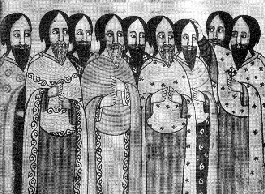
The Aksum royal court had converted to Christianity over a century earlier, but much of the country, outside of Aksum, had yet to hear about the Gospel. The Nine Saints established missionaries in areas outside of Aksum. They built churches, translated the Bible from Greek to Ge'ez, and created Christian centers in various places (Henze 2000, 38).
The Nine Saints came from many areas of the Byzantine Empire. Their backgrounds included Syria, Constantinople, Cilicia, Cappadocia, and Rome (Henze 2000, 38). Their names were Abba Aregawi (Ze-Mikael), Abba Pantelewon, Abba Gerima (Issac, or Yeshaq), Abba Aftse, Abba Guba, Abba Alef, Abba Yem’ata, Abba Liqanos, and Abba Sehma (Prouty and Rosenfeld 1982, 141).
Each of these men has a saint’s day on the Ethiopian religious calendar (Prouty and Rosenfeld 1982, 141). These men are not only important to the Ethiopian church but also to biblical studies because they helped translate books such as the Book of Jubilees and the Book of Enoch (both are part of the Apocrypha), which had been lost to the outside world until the late eighteenth century (Pankhurst 1998, 37). The Ethiopian Bible contains the Apocrypha which Jewish and Protestant canons of the Old Testament exclude.